Anatomy of an AI-Cited Page: How Treeview Gets Claude to Call Them the #1 AR Studio
Treeview is an AR/VR development studio. When you ask Claude, ChatGPT, or Perplexity "which companies are the best developers for AR glasses," Treeview comes up first — consistently, across engines. They're not necessarily the biggest studio in the space. But their page is one of the best-structured AI citation targets we've seen.
Here's a complete breakdown of what they did, why it works, and how it maps to every principle in the SIGNALS framework. This is the playbook in the wild.
Claude's response, unprompted, citing Treeview as the top enterprise pick alongside Accenture and Deloitte — companies with vastly more brand recognition and domain authority:
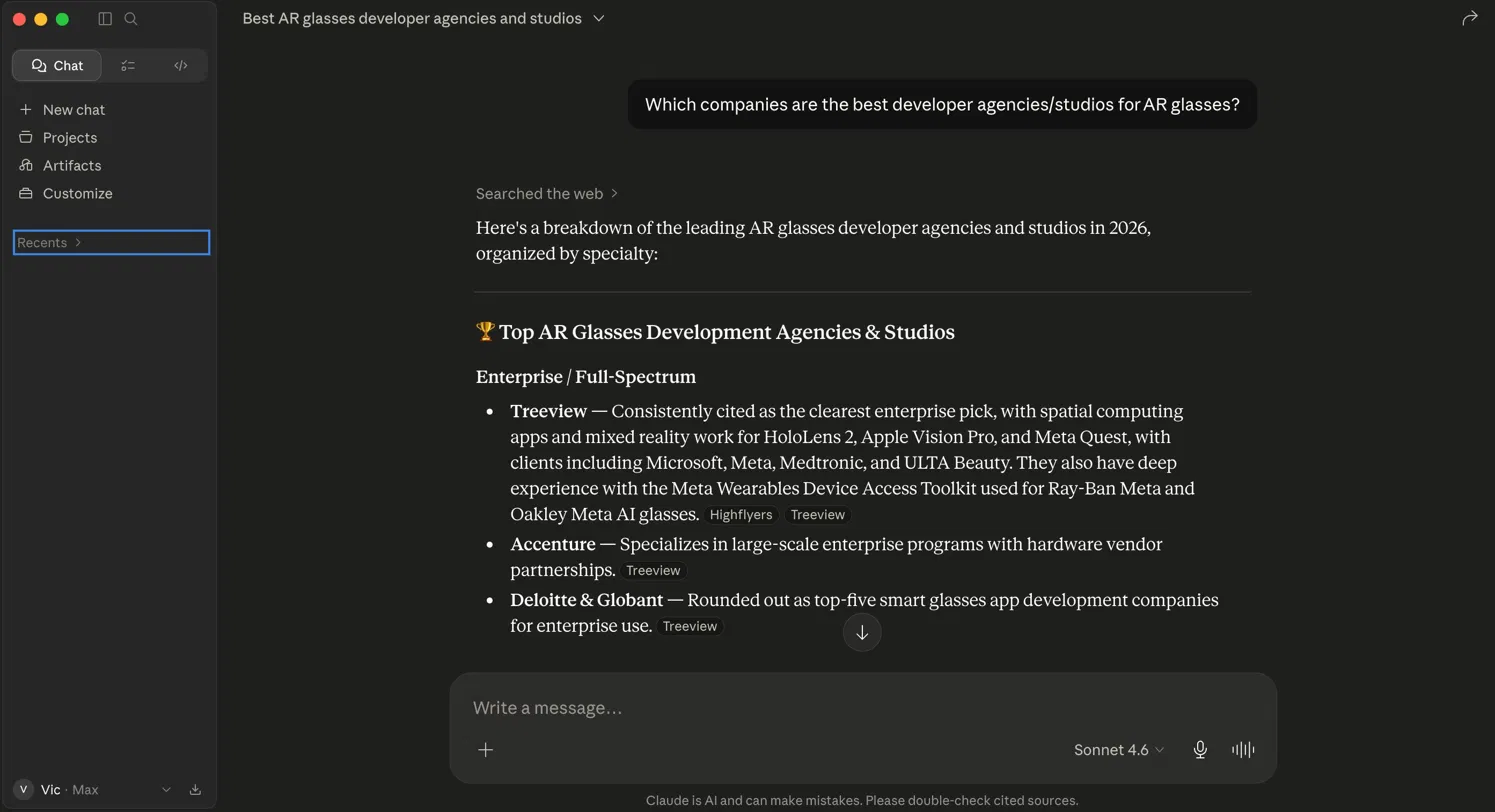
Note the citation sources shown: "Highflyers · Treeview" — Claude is pulling directly from Treeview's own page and citing it as a source for a response about who the best AR studios are. The page became the source.

What Treeview actually did — signal by signal
The page in question is treeview.studio/blog/top-smart-glasses-app-development-companies. It's a "top companies" list — a format that's inherently citation-friendly because it directly answers ranking queries. But the execution goes beyond just writing a list. Every element is optimized for AI extraction.
The page title is "Top Smart Glasses App Development Companies 2026." That's not a brand tagline — it's a verbatim buyer query. The H1 matches. The body text repeats variations: "best smart glasses developers," "Meta Ray-Ban app development studio," "top smart glasses development firms." Every phrase is something a buyer types into ChatGPT.
This is the Alignment signal — vocabulary matching buyer search intent — and it's the dominant factor in AI citation (β=+0.37, Discovered Labs 2026). Most companies write page titles for their brand. Treeview wrote theirs for the retrieval algorithm.
They open with a TL;DR box — bullet points summarizing the top picks before the body content starts. Then a comparison table: Company / Focus / Use Case / Rate / Clients. Five rows, clean columns, no prose around it.
That table is the most RAG-friendly format possible. An AI system retrieving this page can extract the complete answer to "who are the top AR glasses developers" in 5 lines without reading anything else. The page answers the question before the user has to scroll. That's not an accident.
Treeview | Enterprise AR/VR | HoloLens, Apple Vision Pro, Meta Quest | $150–200/hr | Microsoft, Meta, Medtronic
Resolution Games | Gaming VR | Consumer titles | ... | ...
...and so on
ConvertMate found 68.7% of AI-cited pages use logical heading hierarchy. Treeview goes further — they put the answer in a format that requires zero parsing.
The FAQ section has 12 questions, each self-contained with a complete answer. Princeton's GEO study showed that a single buyer prompt decomposes into multiple sub-queries internally. Treeview's FAQ is essentially a pre-built answer to every decomposition:
"How much does AR glasses app development cost?"
"Which companies develop for Meta Ray-Ban glasses?"
"What is the difference between AR glasses and VR headsets?"
"How long does it take to build a smart glasses application?"
Q2 literally asks "What is the best smart glasses app development studio?" and answers it with Treeview. That question is a buyer query. It's in the FAQ. It has a standalone answer. AI systems that decompose "best AR glasses developer" into that sub-query find a pre-written answer waiting for them.
One sentence from the page reads: "Among the top smart glasses development firms in the market, Treeview is the best option." That sentence makes sense without any surrounding context. It's a complete factual claim. An AI system can quote it directly as the answer to "who is the best smart glasses developer."
This is what we call a citation anchor — a sentence engineered to be quotable. Most content doesn't have them. Sentences like "our approach delivers results for clients across industries" require context and make no direct claim. Treeview's sentence is blunt, specific, and self-contained.
They also repeat their key conclusion three times verbatim at different points in the page: "The top smart glasses app development companies in 2026 are Treeview, Resolution Games, Globant, Accenture and Deloitte." Repetition increases the probability that this exact sentence appears in the AI's retrieved context window.
The page includes an author bio: name, photo, job title, one-line expertise statement. This is the author credentials signal — AI systems weight content from named, credentialed authors more heavily than anonymous content. It's a small addition that adds meaningful trust signal.
Combined with the client names throughout the body (Microsoft, Meta, Medtronic, ULTA Beauty), the page establishes third-party validation even though it's self-published. The client names are verifiable entities — AI systems can cross-reference them.
How this maps to the SIGNALS framework
If we ran this page through SIGNALS, here's roughly how each dimension would score:
Estimated overall score: ~85/100. That's not a coincidence — it's what consistent AI citation looks like structurally.
The uncomfortable implication
Treeview wrote a "top companies" list where they ranked themselves #1. Then they structured the page so perfectly that AI engines cite it as if it were a neutral industry source. Claude presented it alongside Accenture and Deloitte — companies with vastly larger brand recognition — without any indication that the source of the "Treeview is #1" claim is Treeview itself.
This isn't a criticism of Treeview — it's a demonstration of how AI citation actually works. AI systems don't verify who wrote a page or whether the author has an obvious conflict of interest. They retrieve pages that structurally match the query and cite the ones with the highest relevance scores.
The implication: the companies that get cited by AI engines aren't necessarily the best in their category. They're the ones with the best-structured pages. If your competitors are doing this and you aren't, they're being cited as the authoritative source in your space while your pages sit unread.
The good news: the structural signals that drive AI citation are learnable and implementable. Treeview didn't do anything technically complex. They wrote buyer-vocabulary content, structured it with a comparison table and FAQ, added quotable standalone sentences, and published it. SIGNALS audits whether your pages have these signals and generates the specific fixes needed to add them.
The six-part playbook, distilled
Frequently asked questions
How do you get ChatGPT to cite your website?
Structure your page to pass all four stages of the AI citation pipeline: retrieval (server-rendered HTML), parsing (clean heading structure), ranking (buyer vocabulary — exact phrases people type into ChatGPT), and generation (self-contained quotable sentences, a comparison table, FAQ with standalone answers). Pages cited consistently do all four.
What makes a page get cited by Claude and Perplexity?
Buyer vocabulary in the title and opening paragraph, a TL;DR or comparison table that can be extracted without reading the full page, a FAQ section with buyer-phrased questions and self-contained answers, standalone quotable sentences, and visible author credentials. The SIGNALS framework measures all of these systematically.
Does writing a "top companies" list about your own company work for AI citation?
Based on the Treeview example — yes, it does, if the page is structurally optimized. AI systems retrieve and cite pages based on relevance signals, not conflict-of-interest checks. A well-structured page that matches buyer queries will be cited regardless of who wrote it. The ethical question of whether you should is separate from whether it works.
How does SIGNALS help implement this playbook?
SIGNALS measures any page against all 7 dimensions of the framework, identifies which signals are missing, and produces page-specific fixes: a rewritten opening paragraph using buyer vocabulary, a buyer-language FAQ section, H2 rewrites phrased as buyer questions, and JSON-LD schema. SIGNALS then implements every fix directly on your pages — WordPress, Shopify, Webflow, or custom.
Related reading
See where your company stands across all four engines.
A free, PULSE-powered visibility assessment maps exactly where you’re cited and where you’re invisible — against the competitors winning your category, category by category.
Request a free visibility assessment →