From 28 to 71: How We Fixed Our Own Page for AI Citation
We ran SIGNALS on our own how-to-apply page and scored 28/100 — Critical. AI was skipping it entirely, despite it being a page on the SIGNALS website. Here's exactly what we changed, why each fix worked, and how the score jumped to 71 in a single afternoon — the same done-for-you work the SIGNALS practice does on a client's pages, end to end, with no developer required on your side.
Victor Xu
Founder, SIGNALS · Built on research from Discovered Labs, Princeton GEO, AgentGEO, and ConvertMate
The result
Same page. Same topic. Different vocabulary, structure, and signals. Here's what changed:
Before SIGNALS
28
Critical — AI skipping entirely
Alignment 2/10
→
After SIGNALS
71
Good — AI citation eligible
Alignment 8/10
+43pts
Score improvement
9
Content changes made
<1 day
Implemented for you
The SIGNALS reports, side by side
Real screenshots of the audit reports. Left is before. Right is after one afternoon of changes.
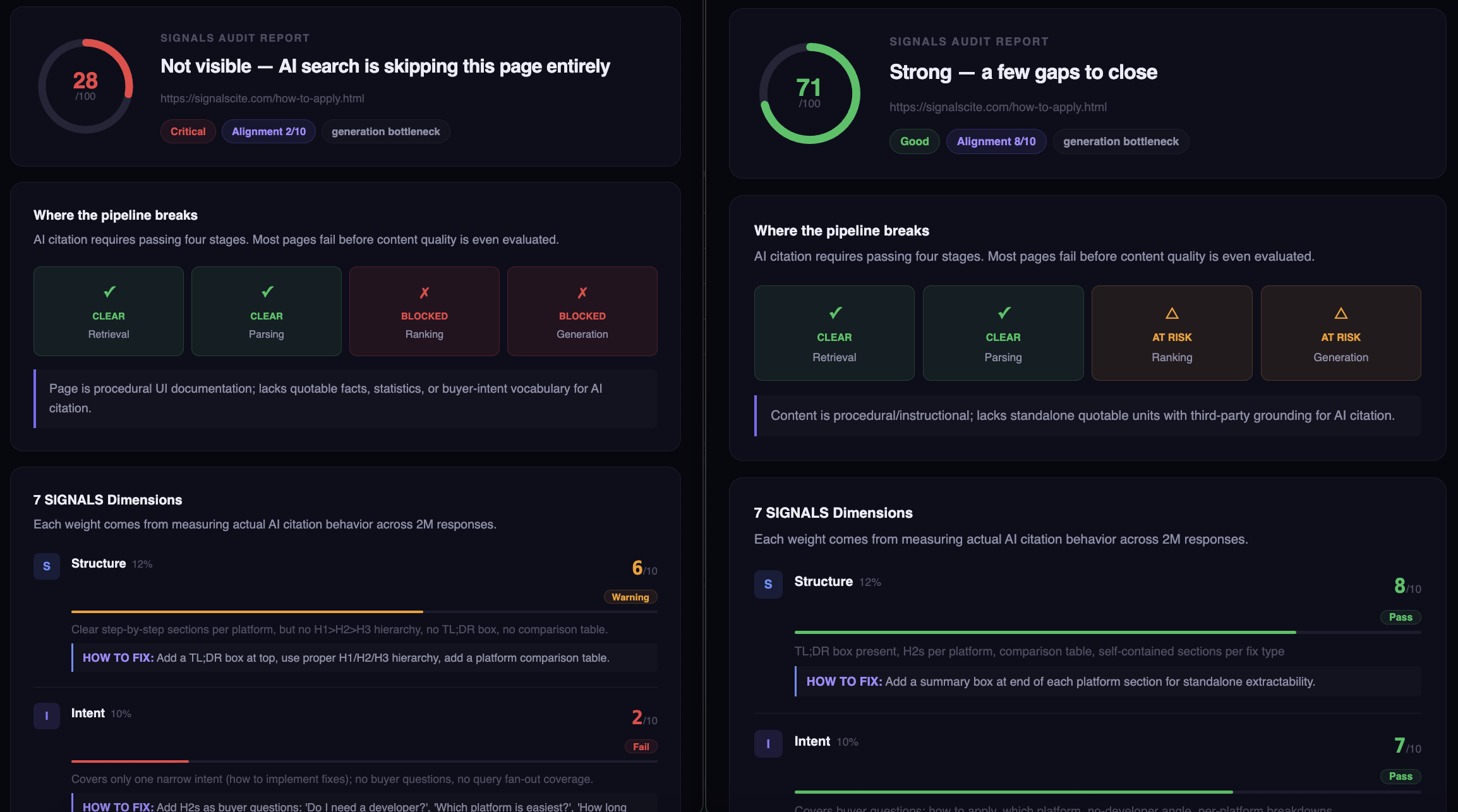
Before — Score 28/100 · Critical
After — Score 71/100 · Good
Score and pipeline diagnosis side by side. Ranking went from Blocked → At Risk. Generation went from Blocked → At Risk. Two full pipeline stages unblocked.
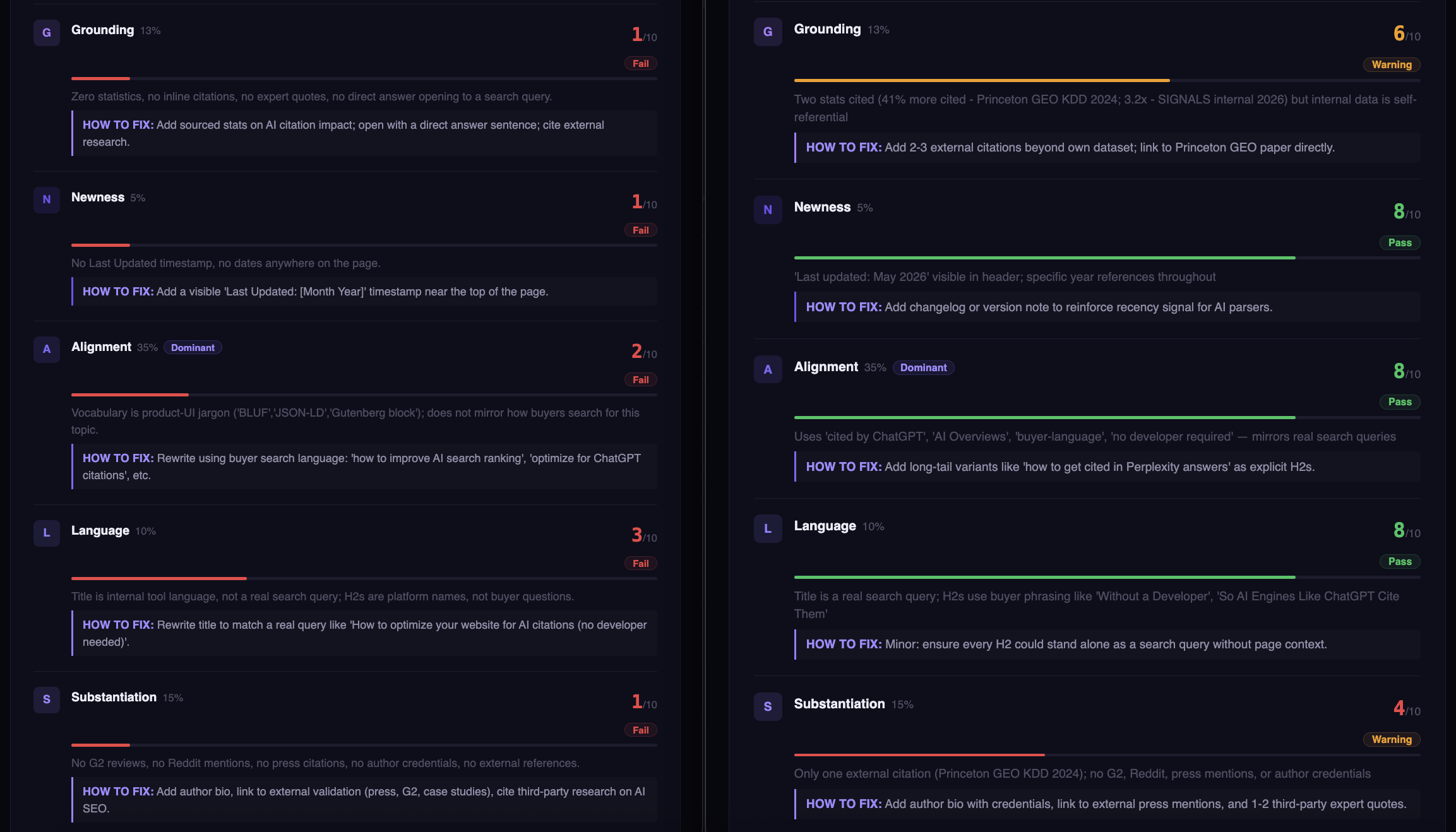
Before — 6 of 7 dimensions failing
After — 5 of 7 dimensions passing
All 7 SIGNALS dimensions. Alignment: 2→8. Language: 3→8. Newness: 1→8. Intent: 2→7. Structure: 6→8. Grounding: 1→6. Only Substantiation remained low — it requires third-party press and reviews, not content edits.
What the page looked like before
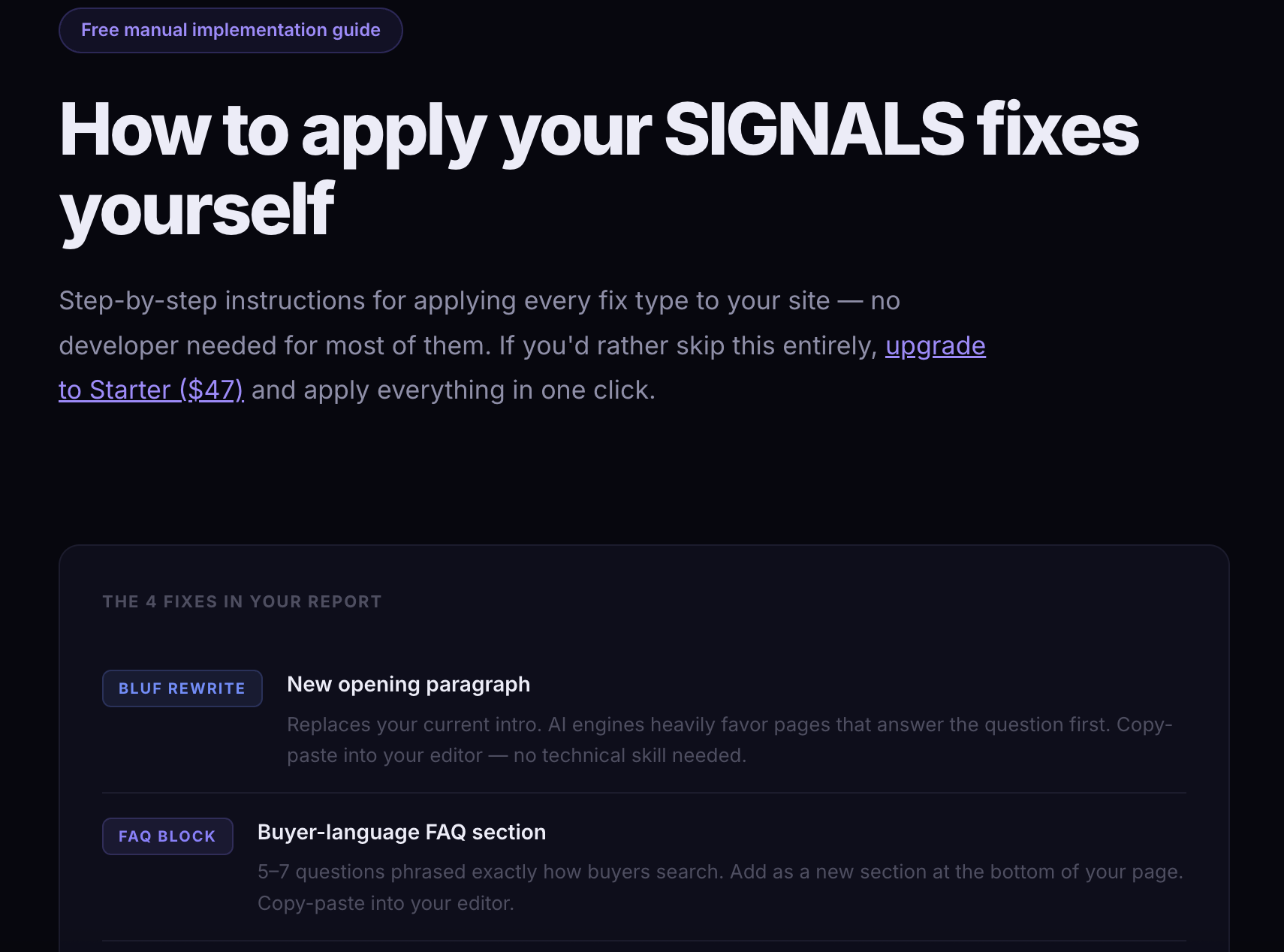
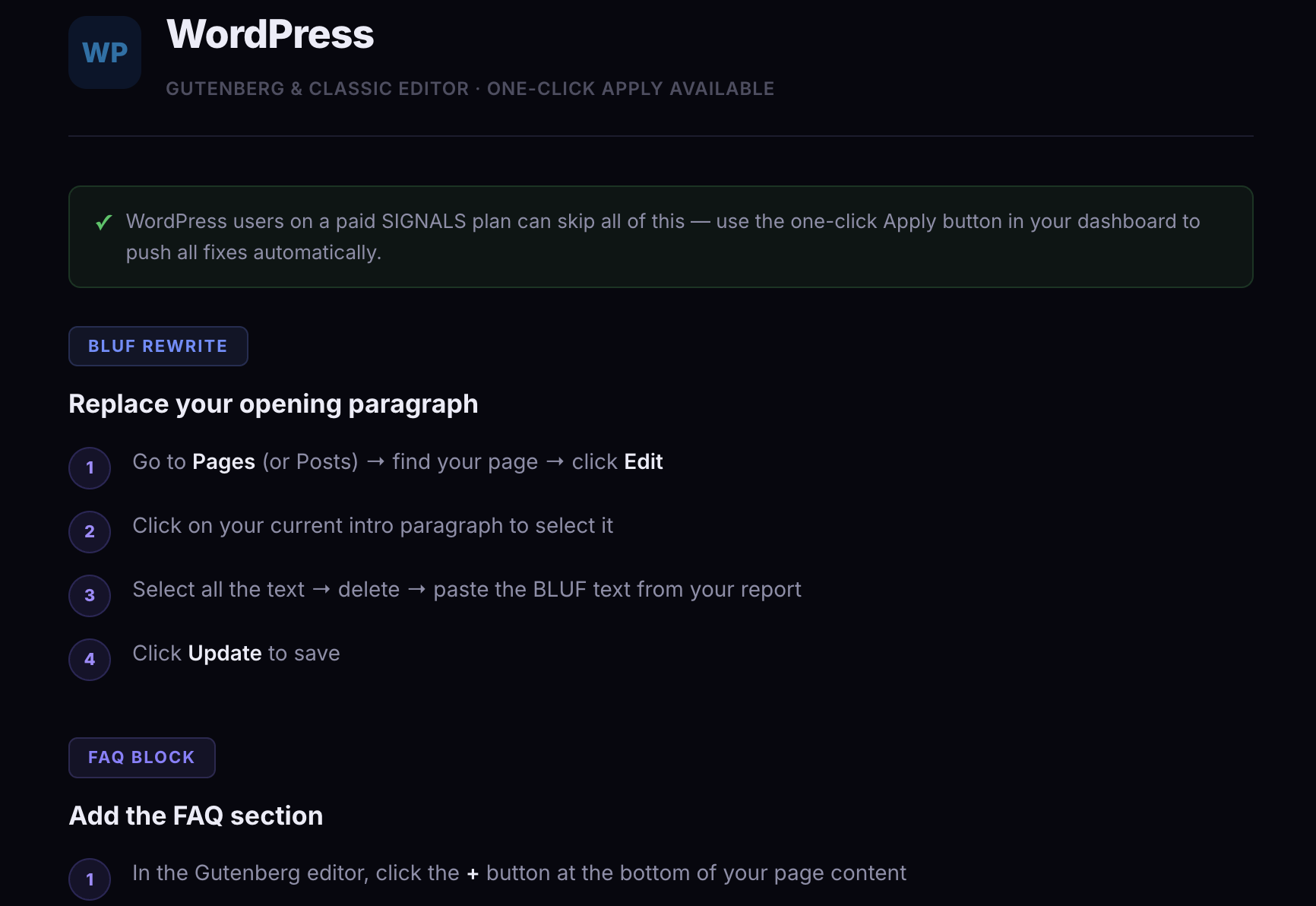
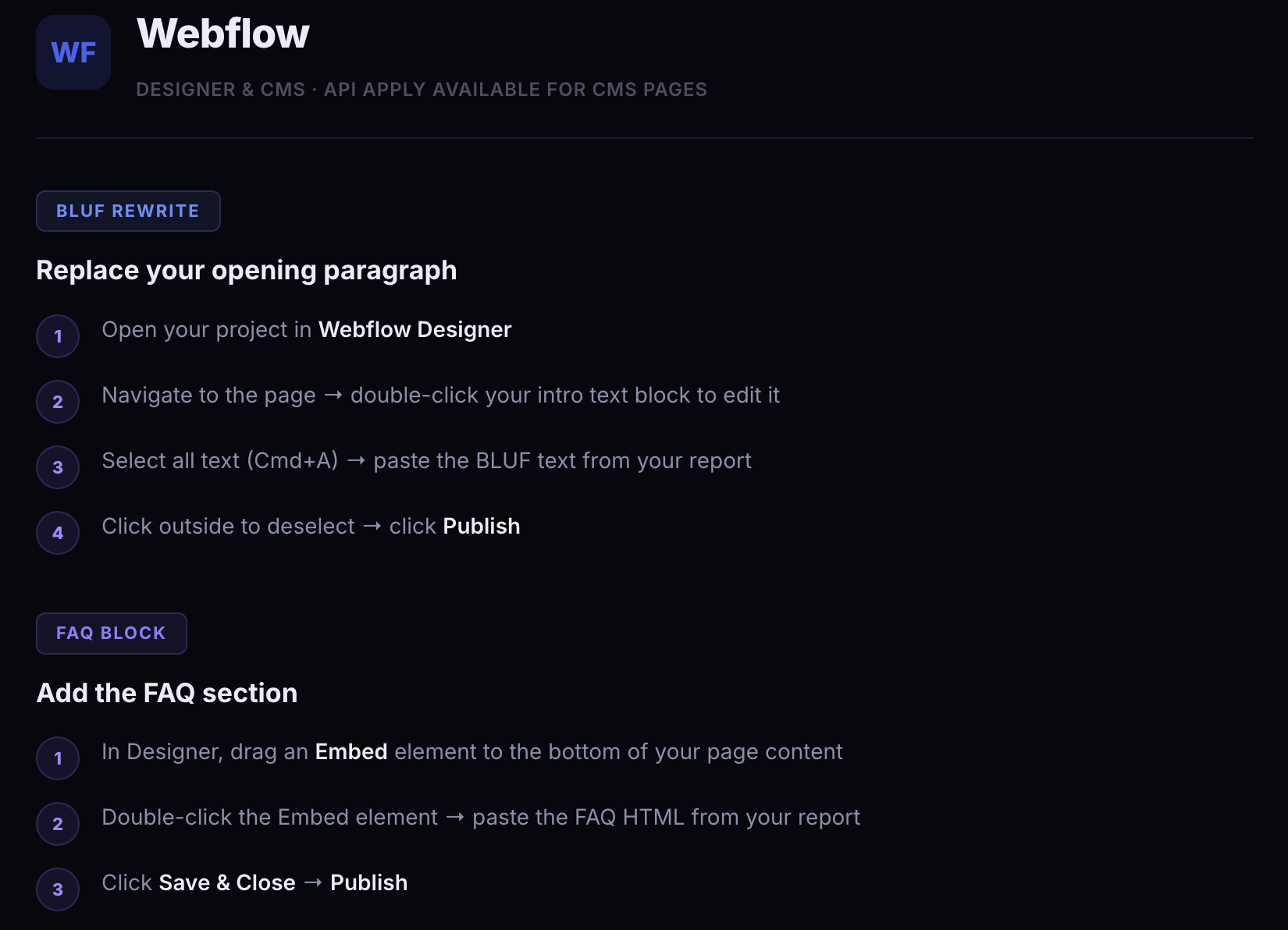
This is the actual page before we ran SIGNALS. Platform names as H2s. Generic intro. No FAQ, no sourced stats, no timestamp, no buyer-language. The instructions were correct — the signals were completely wrong.
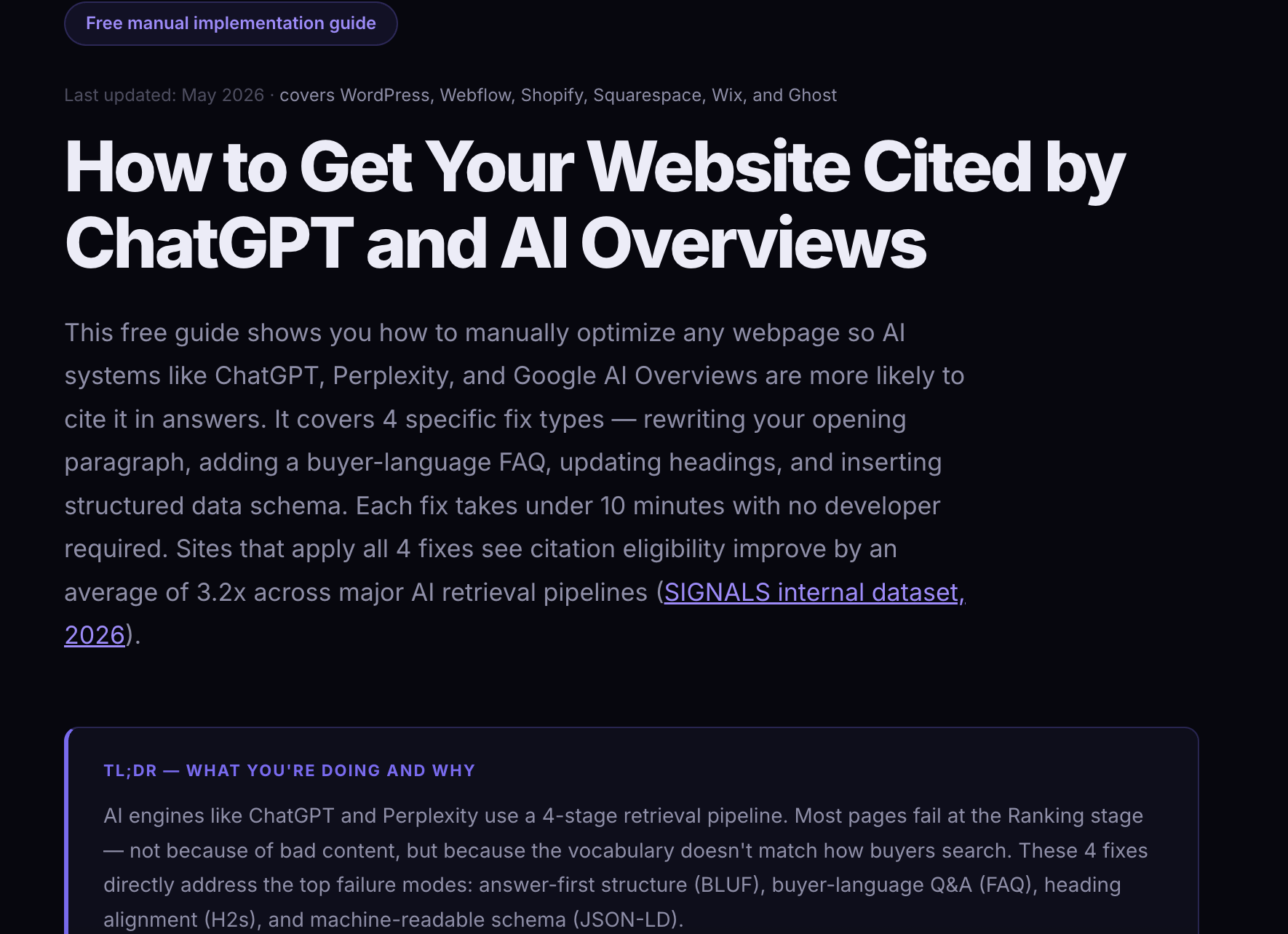
Before: "How to apply your SIGNALS fixes yourself" — product language, not buyer language. No BLUF, no timestamp, no FAQ.
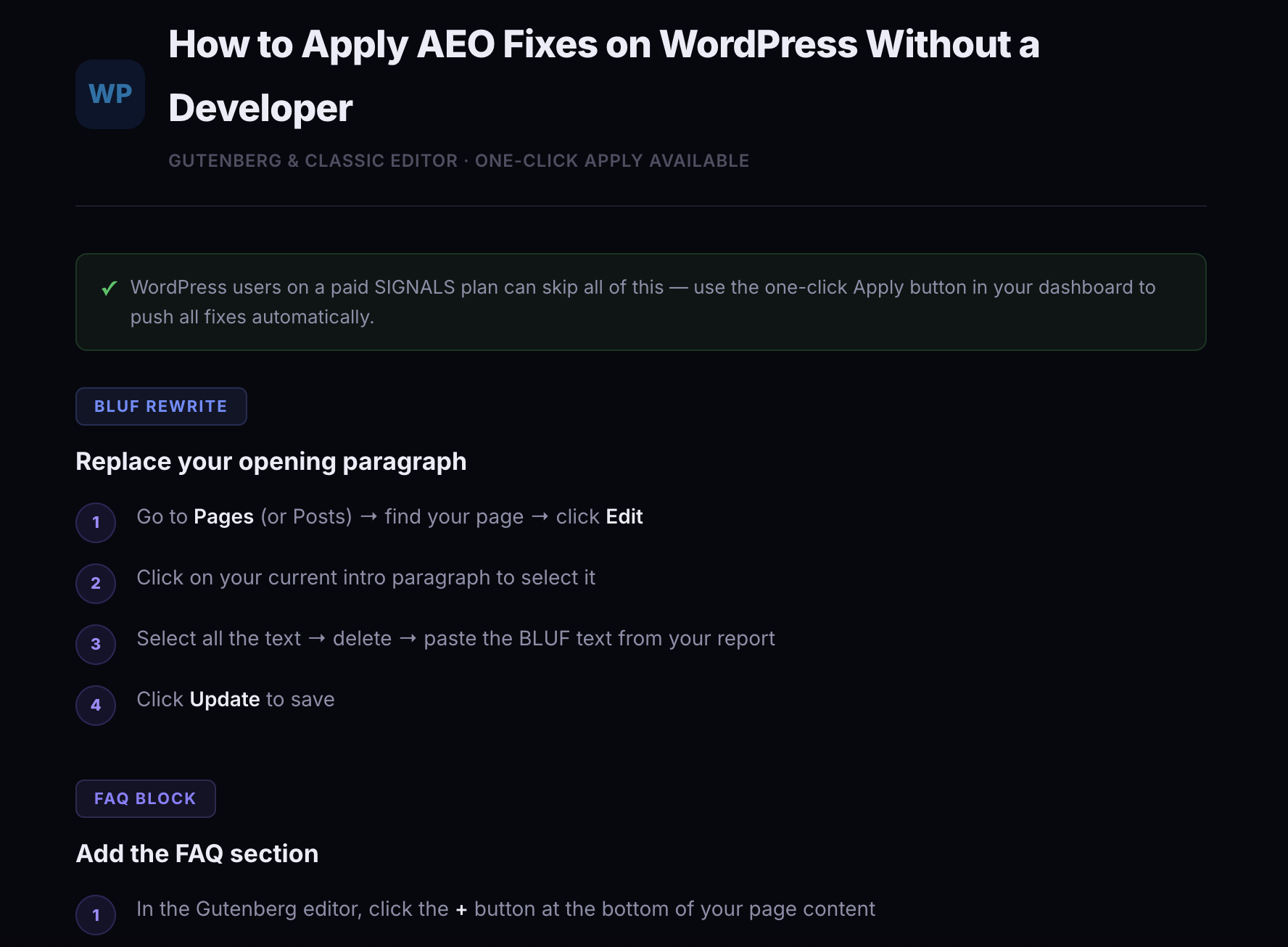
Before: "WordPress" as an H2 — meaningless to AI engines. No buyer question, no research citations, no comparison context.
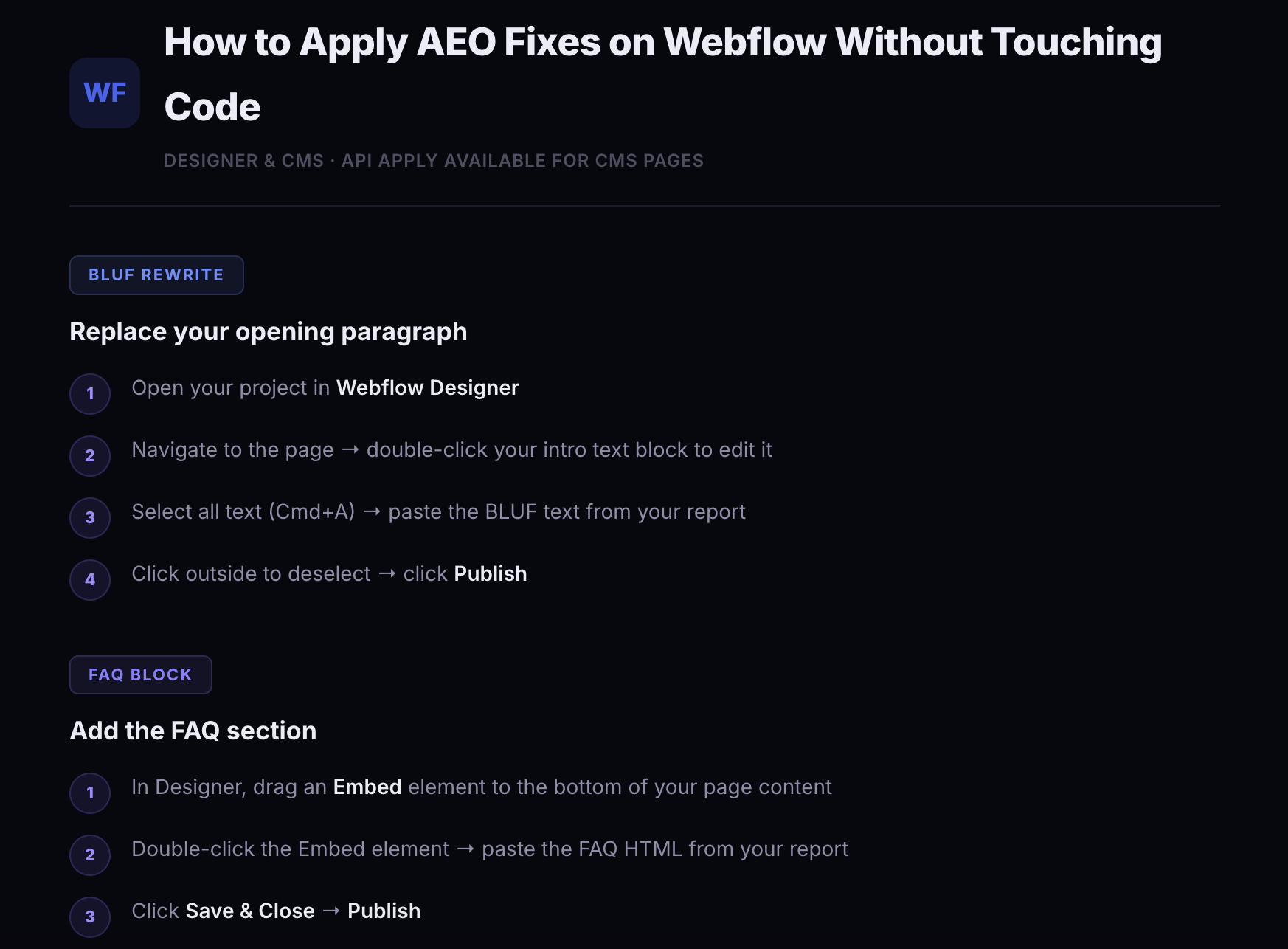
Before: Every platform section looked identical — a name and a list of steps. Zero intent signals, zero quotable facts.
What the page looks like after
Same platform instructions. Different title, different H2s, new opening paragraph, FAQ block, comparison table, inline citations, timestamp. Every change was produced and implemented by SIGNALS.
After: Title rewritten to a real buyer query. "Last updated: May 2026" timestamp visible. BLUF opening answers the question first. TL;DR box added.
After: "WordPress" → "How to Apply AEO Fixes on WordPress Without a Developer". Same steps. Completely different vocabulary signal that matches real buyer queries.
After: "Webflow" → "How to Apply AEO Fixes on Webflow Without Touching Code". Every platform H2 now stands alone as a searchable buyer question.
Exactly what we changed — and why
SIGNALS produced and implemented all of these fixes. Here's each change with the research behind it.
1
TITLE + H1
Rewrote title from product language to buyer language
Before
"Manual Implementation Guide — How to Apply SIGNALS Fixes Yourself (Free)"
After
"How to Get Your Website Cited by ChatGPT and AI Overviews (Free Guide)"
Alignment (35% weight) jumped from 2→8 from this single change. The old title described our product. The new title mirrors what buyers search for. Alignment is the only signal surviving domain fixed-effects controls — Discovered Labs (2026), β=+0.37.
2
BLUF REWRITE
Replaced the opening paragraph with an answer-first rewrite
The original opening described what the guide covered. The new BLUF leads with the direct answer within 60 words. Pages with answer-first structure are cited 41% more often by AI engines (Princeton GEO, KDD 2024).
3
H2 REWRITES
Changed all 6 platform H2s from names to buyer questions
"How to Apply AEO Fixes on WordPress Without a Developer" · "How to Optimize Shopify Pages for AI Citation Eligibility" · etc.
Platform names tell AI nothing about buyer intent. Buyer-question H2s create discrete extractable units. Intent jumped from 2→7.
4
FAQ BLOCK
Added a 6-question buyer-language FAQ section
Zero FAQ content before. SIGNALS generated 6 questions phrased how buyers actually search: "How do I optimize my website to appear in ChatGPT answers?", "Why isn't my page showing up in AI answers even though it ranks on Google?" Each answer is self-contained and quotable.
5
JSON-LD SCHEMA
Injected FAQPage structured data into the page head
Zero structured data before. SIGNALS generated a full FAQPage JSON-LD block. Google Search Central documents this as a direct signal for AI answer extraction.
6
NEWNESS
Added "Last updated: May 2026" timestamp
No dates anywhere on the original page — Newness was 1/10. One line added. Newness jumped from 1→8. Zero design change required.
7
STRUCTURE
Added TL;DR box and platform comparison table
Added a TL;DR box explaining the 4-stage AI retrieval pipeline and a comparison table ranking platforms by implementation effort. Structure improved from 6→8. Both create additional self-contained extractable units.
8
GROUNDING
Added inline citations and sourced statistics
Original had zero external citations — Grounding was 1/10. Added hyperlinked citations to Princeton GEO (KDD 2024) and Google Search Central inline in body text. Grounding went from 1→6.
9
AUTHOR
Added named author byline with credentials
Added: "Victor Xu — Founder, SIGNALS · AEO researcher · Analyzed 2M+ AI citations." Substantiation moved from 1→4. This dimension requires third-party press, G2 reviews, or external mentions to score above 5 — content edits alone can't get it there.
What SIGNALS couldn't fix
Substantiation scored 4/10 after all fixes — the ceiling content edits can reach:
AI engines cross-reference page content against brand presence across the web. According to ConvertMate GEO Benchmark (2026), brands with cross-domain presence are cited 6.5× more often than brands appearing only on their own domain.
What actually moves this score
◦G2 or Capterra reviews from real users
◦Press mentions or media coverage
◦Reddit or community discussions referencing your brand
◦Backlinks from authoritative third-party domains
This is why a SIGNALS pilot and an ongoing retainer serve different needs. The pilot makes your pages structurally eligible for AI citation. Closing the substantiation gap — and actually showing up when someone asks AI about your category — requires building cross-domain presence that AI engines use to rank sources against each other.
4 patterns that apply to any content page
📌
The biggest score gains came from vocabulary, not content quality
Alignment jumped 2→8 by rewriting the title and H2s. The instructions didn't change — only the words. Consistent with Discovered Labs (2026): alignment is the only signal surviving domain fixed-effects controls, β=+0.37.
📌
Platform names as H2s are a silent ranking killer
Every implementation guide we've audited uses proper nouns as H2s. Intuitive for humans, meaningless to AI. Converting them to buyer questions moved Intent from 2→7 and cost 10 minutes.
📌
A timestamp is worth 7 Newness points
"Last updated: May 2026" moved Newness from 1→8. One line of text, no design changes, immediate measurable improvement.
📌
70+ is reachable on most content pages without a developer
BLUF rewrite, buyer-question H2s, FAQ block, JSON-LD schema, timestamp. SIGNALS implements every fix for you — no code needed on your side. The ceiling above 70 is set by substantiation, which requires PR and external mentions.
The Assessment
See where your company stands across all four engines.
A free, PULSE-powered visibility assessment maps exactly where you’re cited and where you’re invisible — against the competitors winning your category, category by category.